Latino Wall Street 101: The Brand, the Mailbox, and the Co-Founder Doing Three to Nine
If you’ve spent any time around the Hispanic conservative scene lately, you’ve seen the logo. It’s on the step-and-repeat at Mar-a-Lago. It’s on the sponsor wall in Washington. It’s printed beside CPAC’s name on conference banners in Florida and Puerto Rico. Latino Wall Street has gone from selling trading courses on the internet to handing out awards to presidents in about six years.
This is the starter kit: what the thing actually is, where it came from, who started it (depending on who you ask and what year it is), why it calls Puerto Rico home, and the co-founder who won’t be making it to the next gala because he’s in a New York state prison.
What it is
At its core, Latino Wall Street is a Spanish-language financial-education business. It sells courses, bootcamps and coaching on stock trading, investing and crypto, aimed at Hispanic families in the United States. It says it has more than 150,000 members. Its course site promises that 87% of the community reports professional benefits in finance, a statistic with no source attached. At the top end, the Centro de Periodismo Investigativo (CPI) reported coaching packages priced up to $250,000 plus 25%.
Around that core it has grown an entire ecosystem: awards shows, investor summits, a partnership with CPAC called CPAC Latino, red-carpet galas at Mar-a-Lago and in Washington, a charity called the Latino Wall Street Foundation, and a super PAC, Latinos for Conservative Values, that shares its address with the Foundation.
One thing to understand early is that “Latino Wall Street” is a brand, not a company. The name is spread across several legal entities: Latino Wallstreet LLC and Latino Wall Street Ventures LLC in Puerto Rico, Wall Street University Inc., the Florida-registered Latino Wall Street Foundation Inc. (formed November 2025), and a “Latino Wall Street Holdings Inc.” that appears in website footers but that we could not find registered in Florida. When a page says “© Latino Wall Street,” that alone doesn’t tell you which of them is actually behind it.
Where it started
The paper trail starts in 2019. The domain latinowallstreet.com was registered on May 30, 2019, the earliest documented use of the name. On September 23, 2019, Latino Wallstreet LLC (one word, Wallstreet) was formed in San Juan, Puerto Rico, registry number 433880. The company’s own math agrees: it celebrated its fourth anniversary in 2023.
In its early years, Latino Wall Street didn’t even stand on its own. A 2022 privacy policy folded it, together with Disrupt Education Services LLC and The Disrupt Foundation, LLC, under one umbrella called “Disrupt,” Tony Delgado’s earlier media and education brand. Its 2022 “Recession-Proof Bootcamp” was streamed “live from our studios in Puerto Rico,” with the privacy and terms pages pointing back to a Disrupt website.
Who started it
This is where it gets slippery, because the founding story changes depending on the year and the audience.
The official record is the Puerto Rico Department of State. The 2019 formation filing lists the company’s authorized persons as Anthony “Tony” Delgado, Gabriela “Gaby” Berrospi, and Alan Burak. A fourth name, Miami nutrition influencer Guillermo Rodríguez Navarrete, was also put on the filing. He says that was done without his consent, and he was removed by an amendment the following month. None of the people listed gave a Puerto Rico address.
Now compare that with how the company has told its own story:
- July 2020: Disrupt, Tony’s own outlet, described Latino Wall Street as an initiative created by Gaby Berrospi and Alan Burak.
- June 2021: In an interview with the Peruvian paper Trome, Gaby told it as her own story, saying she decided to create a company. No Tony, no Burak.
- September 2022: On the bootcamp page, Tony is “CEO & co-founder.” Gaby is “Co-Founder,” and a few lines further down in the same bio, “the founder.”
- January 2023: Latino Wall Street’s Instagram introduced “Alan Burak, Co-Fundador de LWS.”
Today the story is Tony and Gaby, full stop. The third name on the paperwork has been quietly written out. We’ll get to why.
Why Puerto Rico
The public story is about heart. Tony says he flew to Puerto Rico after Hurricane Maria in 2017 to help rebuild, and then moved there full time.
The paper story is about taxes.
Puerto Rico offers some of the most generous tax incentives under the U.S. flag, and Latino Wall Street collected the full set:
- Gaby: Act 22 “individual investor” decree, June 19, 2020.
- Tony: Act 22 decree, October 26, 2020.
- Latino Wall Street: Act 20 “export services” decree, July 7, 2021.
In plain English: an Act 20 business that sells services from Puerto Rico to customers outside the island, such as online courses streamed to Latinos in Miami, Houston or New Jersey, pays around 4% tax on that eligible income instead of the 21% federal corporate rate. An Act 22 resident pays 0% Puerto Rico tax on dividends and interest, and on capital gains built up after the move. And because bona fide Puerto Rico residents generally don’t pay federal income tax on Puerto Rico-source income, profits that flow from the company to its owners can end up taxed at close to nothing from top to bottom. Puerto Rico’s Department of Economic Development and Commerce confirmed to CPI that all three decrees were still in effect as of May 2026.
Those perks come with strings attached. Decree holders have to be genuine residents, living on the island at least 183 days a year with closer ties there than anywhere else. They have to buy a home there within two years, pay an annual fee, give $10,000 a year to Puerto Rico nonprofits, and actually run the business from Puerto Rico. The company also has to stay in good standing.
Here’s what the record shows on those strings:
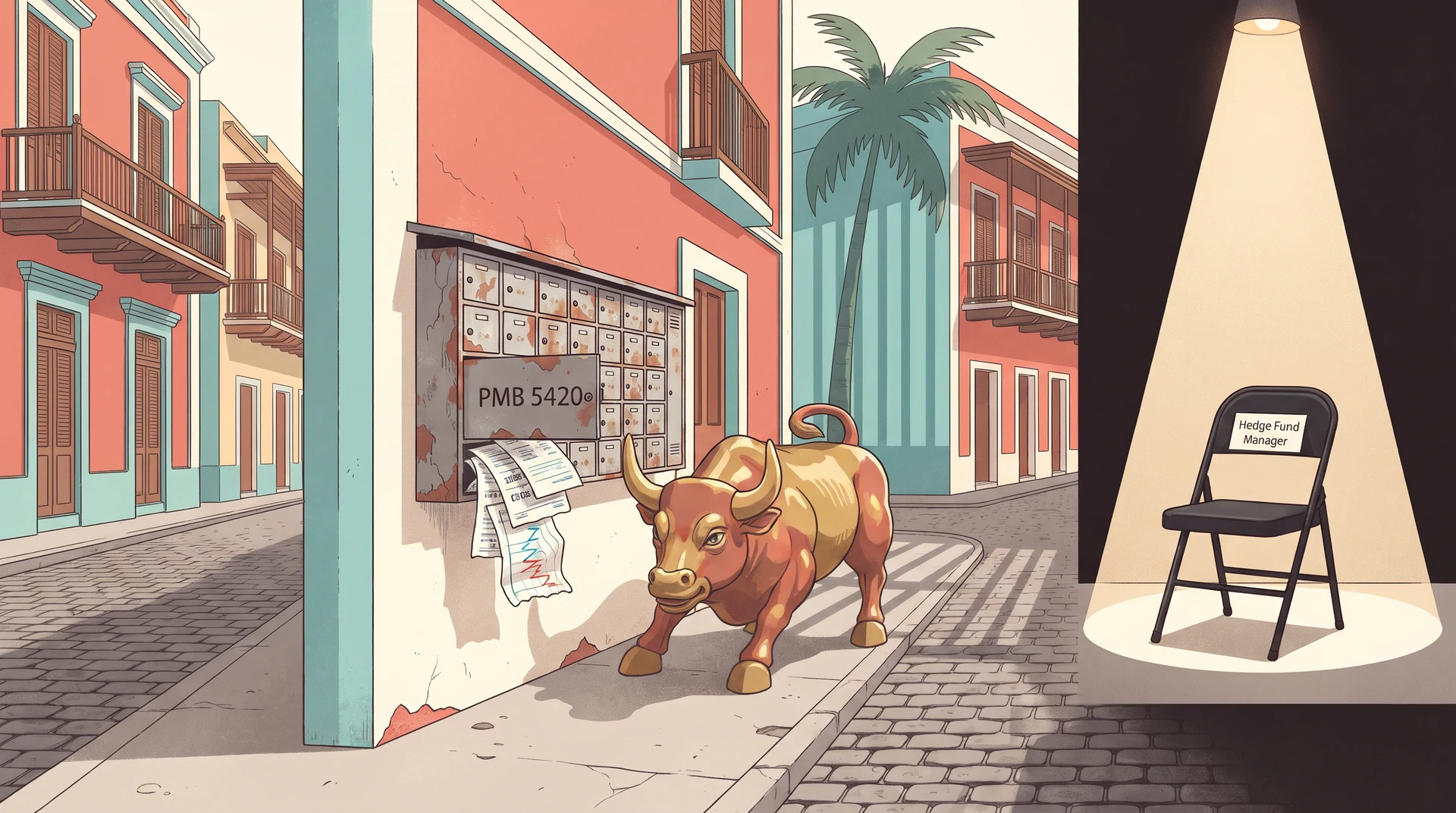
- The “headquarters” is Suite 200, PMB 5420, at a co-working building in Old San Juan. PMB stands for private mailbox.
- The resident agent is Stolberg Law, a firm that sells itself as a one-stop shop for Act 20, 22 and 60 incentive applications. Its San Juan office is a virtual office in the same building.
- Standing: Latino Wallstreet LLC skipped its annual reports for 2021, 2023 and 2025 and owes about $3,179 in fees and penalties. Puerto Rico lists it as not in good standing. The newer Latino Wall Street Ventures LLC, formed in August 2025, missed its very first annual report and owes another $710.74. That’s a financial-literacy company that can’t keep up with a $150 annual filing fee.
- The addresses keep pointing north. The super PAC and the Foundation both sit at 770 SE Indian St in Stuart, Florida. The Foundation’s original filing used a Miami suite. Gaby’s voter registration is at a New York address.
So why is Latino Wall Street in Puerto Rico? On paper, because that’s where the tax decrees are. Whether anybody is actually in Puerto Rico is another question.
The co-founder in prison
Alan Burak was not a side character. Latino Wall Street put him in front of its students over and over:
- In a 2020 press release he was billed as a “Mexican Hedge Fund Manager in New York.”
- In June 2021 he gave the closing keynote at a Latino Wall Street event at the Marriott Marquis in Times Square.
- In July 2021 the company announced a Times Square billboard and called him a “Manhattan-based Hedge Fund Manager.”
- In September 2022 he was a featured speaker at the Recession-Proof Bootcamp, introduced as a hedge fund manager from Never Alone Capital.
- In January 2023 the company’s Instagram called him a co-founder, and he was promoted at its fourth-anniversary celebration that year.
Never Alone Capital was not a hedge fund. According to the Manhattan District Attorney, it was a fake investment firm that Burak used to steal more than $4 million between April 2018 and May 2023. He started by recruiting family and friends in Mexico. Then, in the DA’s words, he spoke for an organization that provides financial education to the Latino community and asked its students to invest. These were people with modest savings who trusted him because he was their instructor. He told them he held securities licenses, managed $157 million, and could return 50% in three months.
The SEC sued him in February 2025 (SEC v. Burak, Southern District of New York). The complaint doesn’t name the education company. It calls it “Company A” and describes it as founded by a married couple who teach Latinos how to invest in the stock market. According to the SEC, at least six of Burak’s investors came to him through Company A. We wonder who that could be.
The SEC complaint also includes a voice memo Burak recorded to himself in 2022, the same year Latino Wall Street was introducing him to students as a hedge fund manager: “I am failing because I am fake.” In the same memo he says he is literally stealing money from people.
To be fair to the founders, the SEC says they were victims too. In February 2023 they put $25,000 into one of his funds, and by that summer they were threatening legal action to get it back. That still leaves an awkward question for a business whose entire product is teaching people how to evaluate an investment: the people selling the course couldn’t spot the fraud standing on their own stage, and spent years telling their students he was the expert.
On March 31, 2026, Burak pleaded guilty in New York State Supreme Court in Manhattan to first-degree grand larceny, first-degree scheme to defraud, and two counts of securities fraud under New York’s Martin Act. The deal: 3 to 9 years in state prison and $4.1 million in judgments for 12 victims. He is now held at Wyoming Correctional Facility in Attica, New York. His first parole appearance is set for April 2027, his earliest release date is February 2028, and his sentence runs out in February 2034.
A footnote for anyone counting on friends in high places: Burak’s conviction is a state conviction. A presidential pardon can’t touch it, no matter who shows up at the gala.
Coming up
This is the front door. Next we follow the money and the guest lists: the Mar-a-Lago and Washington galas and who paid for the tables, the super PAC that paid for gala production while reporting it as support for a candidate who wasn’t there, and a brand-new charity selling $250,000 sponsorships.
Sources
- Manhattan District Attorney, “D.A. Bragg Announces Guilty Plea in Multi-Million-Dollar Investment Fraud Scheme,” March 31, 2026
- SEC v. Burak, No. 1:25-cv-01626 (S.D.N.Y., filed Feb. 26, 2025)
- Hoodline, Burak guilty plea coverage, April 2026
- Centro de Periodismo Investigativo, “CPAC Latino Puerto Rico,” May 2026
- Puerto Rico Department of State corporate registry: Latino Wallstreet LLC (no. 433880) and Latino Wall Street Ventures LLC (no. 559444)
- New York State DOCCS incarcerated lookup: Alan Burak
- Florida Division of Corporations (Sunbiz): Latino Wall Street Foundation Inc. (N25000015277)
- Latino Wall Street’s own pages, press releases and Instagram posts (archived copies on file)
PAY TO PLAY: Access For Sale
The people, companies, PACs and galas in this story are part of a much bigger web. Our interactive network map follows the money and the guest lists from Mar-a-Lago and Washington to Buenos Aires, Madrid, Brasília and beyond. Switch categories on and off, click any name to see who it connects to, and check the public source behind every line.